In order to mark the European Anti-Trafficking Day, the Center for Girls organized several events in October in Niš:
1) On October 17, 3 workshops on the "Prevention of Human Trafficking" for the students of Fashion and Beauty High School, educating 52 students of I, II and III class of this school in the process
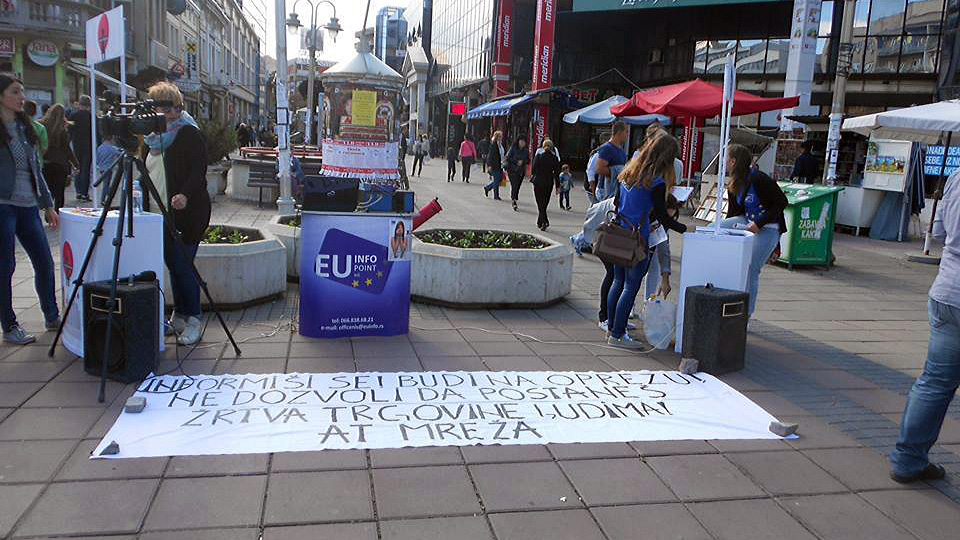
2) On October 18, a street action in front of Kalča Business Center lasting from 12:00 to 13:00 in cooperation with EU Info Corner Niš, where promotional leaflets were distributed and citizens were informed about the problem of human trafficking. With this action, the activists of the Center for Girls and EU Info Corner Niš wanted to draw citizens' attention to the fact that millions of children and half a million women a year become victims of human trafficking, and that anyone can fall victim to human trafficking, especially uninformed people. The activists tried to warn citizens with a message: “Get informed! Be on the alert! Don't allow yourself to become a victim of human trafficking! AT NETWORK“ and distributed promotional material informing citizens of the problem of human trafficking
3) On October 23, an educational workshop on the "Prevention of Human Trafficking" in cooperation with EU Info Corner Niš, involving 20 high-school girls. The workshop was held by Silvija Mihajlović, an activist of the Center for Girls
4) At 12:00 on October 24, a panel discussion "Networking against Human Trafficking" with Olivera Otašević Krsmanović (Astra Belgrade), Duško Klikovac (Ministry of Interior Niš), Javorka Ranđelović (Social Work Center Niš), Tatjana Nikolić (Center for Girls Niš) and Milan Stefanović (EU Info Corner Niš) speaking in front of the packed hall of Media Center Niš. The goal of this panel discussion was to bring together all relevant institutions and organizations in the city of Niš in order to share information on anti-trafficking action and to further expand networking among our institutions and organizations for the purpose of more efficient struggle against human trafficking.
5) In the last week of October, 3 workshops on the "Prevention of Human Trafficking" for the students of Fashion and Beauty High School
In Vršac:
On October 18, the European Anti-Trafficking Day, the Center for Women's Rights in Vršac launched a campaign named "It is Important to Know" with financial help from the Municipality of Vršac. The Center for Women's Rights in Vršac marked this day by going out into the city square, and warned the citizens about the risks of human trafficking by distributing leaflets. 25 workshops were held, 20 out of which were with pupils of 7th and 8th grade of elementary schools, and 5 with adults who attended school within the Second Chance project. Banat Television and EVršac – the portal of Vršac reported on the action
In Belgrade:
Regional conference "Access to Compensation to Trafficked Persons in the Region", which was organized by ASTRA – Anti-Trafficking Action in partnership with MSF EMMAUS from Bosnia and Herzegovina, Partnership for Social Development from Croatia, Open Gate – La Strada from Macedonia, Netherlands Helsinki Committee from the Netherlands, and Committe Contre L’Esclavage Moderne and Accompagnement, Lieux d’Accueil, Carrefour educatif et social from France, was held in the Small Hall of the National Assembly of Serbia on October 17-18, 2014.
This conference is a final activity of the regional project "Balkans ACT (Against Crime of Trafficking) Now!“ which has been implemented over the last two years with the support of the European Union (IPA CSF), the Royal Netherlands Embassy in Serbia, the Embassy of France in Serbia and the Open Society Foundation.
In the introductory part of the conference, the participants were addressed by H.E. Christine Moro, French Ambassador to Serbia, H.E. Laurent L. Stokvis, Dutch Ambassador to Serbia, Karolina Vrethem, representative of the EC Directorate-General for Enlargement, Mitar Đurašković, Serbian Anti-Trafficking Coordinator and Tamara Vukasović, project coordinator and chairwoman of ASTRA.
Through comparative overviews of different models from the region, the speakers presented different ways of regulating access to compensation to trafficking victims, as well as the existing legal acts within whose framework the right to compensation may be exercised. Dutch independent expert Marjan Wijers presented international standards in the area of compensation and different mechanisms of access to compensation to trafficked persons, while the challenges identified in this area in the region were discussed by Hajrija Hadžiomerović-Muftić, prosecutor of the Prosecutor’s Office of the Federation of Bosnia and Herzegovina, Milan Žarković, professor at the Academy for Criminalistic and Police Studies (Serbia), Munir Podumljak from the Partnership for Social Development (Croatia) and Jasminka Friscik from the Association for Emancipation, Solidarity and Equality of Women (Macedonia).
Experts in the area of human rights and rights of trafficked persons from France and the Netherlands – lawyers Anne Bouillon and Annet Koopsen, as well as a former judge and current legal advisor at the Ministry of Justice Charles Tellier and the Chairman of the Commission of the Dutch State Compensation Fund Ludo C.P. Gosen, gave the examples from practice that may serve as recommendations for building a realistic legal and institutional framework, and systemic measures that would ensure effective access to compensation to victims in the countries in the region. “Until recently, a victim of trafficking in France was out of the focus – all the attention was on the perpetrator. Fortunately, that has changed. Now the victim is in the center of interest”, said Anne Bouillon, a lawyer from Nantes.
In the session on possible strategies and solutions to improve access to compensation to trafficked persons, lawyer Aneta Trajkovska talked about the practice of deciding on victims’ compensation claim in criminal proceedings in Macedonia. Radmila Dragičević Dičić, the judge of the Supreme Court of Cassation of Serbia and Slobodan Josimović from the Novi Sad Higher Prosecutor’s Office presented recommendations for improving access to compensation for victims of violent crimes produced by ASTRA’s group of experts. Eldan Mujanović, PhD from the Faculty for Criminal Justice, Criminology and Security Studies (University of Sarajevo) discussed possible solutions for overcoming challenges in this area in Bosnia and Herzegovina, and Munir Podumljak from the Partnership for Social Development presented possible solutions for improving compensation system in Croatia.
Having listed positive steps made in the Republic of Serbia in the previous years, Tamara Vukasović, the chairwoman of ASTRA and coordinator of the BAN project closed the conference “Access to Compensation to Trafficked Persons in the Region” with hope that more will be done in the anti-trafficking field in the future and that trafficked persons will always be observed in the context of human rights.